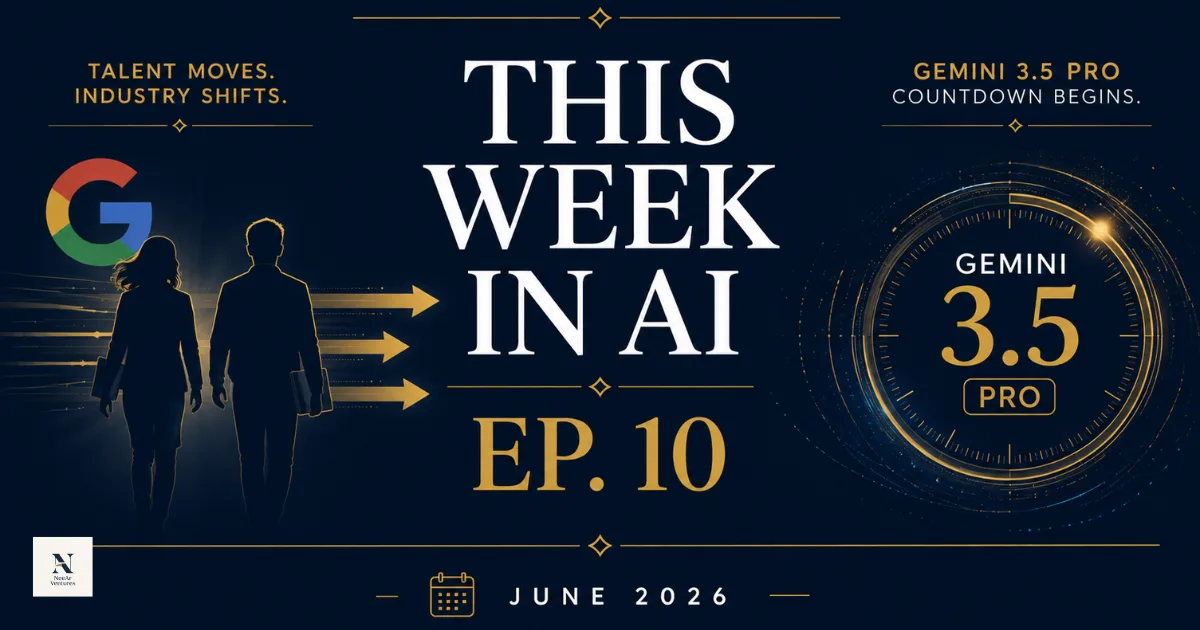
The man who invented the Transformer — the architecture underneath every major AI system alive today — just switched teams. Noam Shazeer spent three years building Character.AI, got bought back by Google for $2.7 billion, stayed 22 months, and this week joined OpenAI as Lead for Architecture Research. The same week, Google's other most consequential researcher — Nobel laureate John Jumper of AlphaFold — left for Anthropic. Google lost both of them in five days.
This week in AI (June 21–27, 2026): Google's Gemini 3.5 Pro is racing a self-imposed June 30 deadline with a 2-million-token context window and Deep Think reasoning — prediction markets at 50–55% odds of hitting it. GPT-5.6 launched with a 1.5M-token context window, an alignment fix for the “Goblins” reward hacking failure, and a US government review before launch. Noam Shazeer (co-author of “Attention Is All You Need”) left Google DeepMind for OpenAI; Nobel laureate John Jumper left for Anthropic. Satya Nadella warned AI giants cannot keep promising mass job destruction while demanding unlimited power to build. OpenAI struck a multi-year display deal with Getty Images covering 400 million assets.
1 Gemini 3.5 Pro — Google's Most Anticipated Model Is Racing a Deadline
What is confirmed
Gemini 3.5 Pro targets a 2-million-token context window, a Deep Think reasoning mode, and frontier multimodal understanding across text, images, and other formats. In Google's lineup, Pro absorbs the use cases previously routed to the top “Ultra” tier. Pricing is expected around $15 per million input tokens and $60 per million output tokens — approximately ten times the cost of Gemini 3.5 Flash. Deep Think is gated to the $250/month Ultra subscription tier.
At 2 million tokens, a single API call can hold: a 2,000-file TypeScript monorepo, three years of Slack export from a 30-person team, or four full SEC S-1 filings simultaneously for comparative financial analysis. No other production frontier model currently offers this at scale. For financial teams, legal research, or large codebase work — this is a genuine differentiator, not a benchmark number.
What it means
Sundar Pichai told the Google I/O audience to “give us until next month” for Gemini 3.5 Pro. That next month is almost gone. If Gemini 3.5 Pro misses its June GA, Google faces a second consecutive I/O credibility gap that could accelerate enterprise buyers toward Anthropic and OpenAI alternatives.
Gemini 3.5 Pro is arriving into the most favourable competitive opening Google has had in 18 months. Claude Fable 5 was disabled globally on June 12. GPT-5.6 is a recent release with no extended track record yet. Enterprise teams that built agent pipelines around Fable 5's capabilities have been on stopgaps since June 12. Neither Opus 4.8 nor GPT-5.5 offers 2M context. If Pro ships this week, it steps into a gap that no other model is filling.
Honest caveat: There is no public model card, no published benchmarks, and no confirmed API pricing. Everything claimed about Gemini 3.5 Pro's capabilities remains Google's own framing until independent testers evaluate it at GA. Treat third-party benchmark figures in circulation as pre-GA estimates, not verified specs.
2 Google Loses Its Two Most Important AI Researchers in Five Days
What happened
Shazeer co-authored Attention Is All You Need, the 2017 paper that introduced the Transformer architecture underlying every major AI system today — GPT, Gemini, Claude, Llama. He left Google in 2021 for Character.AI, was re-hired by Google for $2.7 billion in 2024, and announced on June 18, 2026 that he is joining OpenAI as Lead for Architecture Research — the person responsible for designing the structural foundations of future OpenAI models. Sam Altman called it a hire he had “wanted since the very beginning of OpenAI.”
John Jumper won the Nobel Prize in Chemistry in 2024 for AlphaFold, the AI system that solved the 50-year protein folding problem. His departure from DeepMind is the second high-profile AI talent loss for Google in a single week. His role at Anthropic has not been officially announced, but the hire is expected to accelerate Anthropic's AI for science initiatives — protein structure, drug discovery, and computational biology.
What it means
In five days, Google lost the architect of the Transformer (the foundational technology of all modern AI) to OpenAI, and the scientist who made its most consequential real-world application (AlphaFold) to Anthropic.
Alphabet stock closed up 1.17% on the Shazeer news — implying that Google's compute moat outweighs any single researcher. That's probably right in the short run. But in an industry where the next architecture breakthrough is worth more than almost any other asset, losing the person most likely to find it is a signal that compounds.
— NeeAr Ventures Editorial
OpenAI is recruiting for architecture — how models are structured. Anthropic is recruiting for science applications — what models can do in the real world. Google, despite paying more in absolute terms for talent retention, is losing on both fronts simultaneously. That pattern matters more than any single departure.
3 Satya Nadella Turns on His Own Industry
What happened
In a blunt Wall Street Journal interview, Microsoft CEO Satya Nadella warned that AI giants cannot keep promising mass job losses while demanding the power to build whatever they want. Three quotes that matter:
- “If all the value is accrued by only a few models, the political economy will simply not tolerate it.”
- “You can't say, hey, all white-collar jobs are gone and this could even be a weapon, and we will use all the power to build data centres.”
- “We now have to do the hard work in earning the social permission.”
Although Nadella did not explicitly name OpenAI, Anthropic, or Google, his remarks were a direct hit at the companies leading the frontier model race. His alternative vision: every organisation should build its own “learning loop” from its private data, rather than depending on a handful of frontier model providers. The interview followed an essay Nadella published on June 14 titled “A frontier without an ecosystem is not stable.”
What it means
The self-interest is visible. A world where AI becomes a commodity that businesses mix and match is a world where Microsoft's distribution through Office 365, Azure, and Windows is worth a lot. Microsoft has invested approximately $13 billion in OpenAI and signed a multibillion-dollar agreement with Anthropic. It is simultaneously the largest financial backer of the companies it is warning against.
The data point that makes it concrete: Uber deployed Claude Code to roughly 5,000 engineers in early 2026 and exhausted its entire $3.4 billion AI budget for the year in just four months — $850 million per month, or roughly $170,000 per engineer per month. That is the specific economic dynamic Nadella was describing: enterprise AI spending compounds as a cost, not an asset.
Nadella's remarks are either a moment of genuine self-reflection — or calculated positioning. Probably some of both. But the anxiety he is voicing is becoming harder for the entire industry to ignore. The political economy test for AI is arriving faster than most labs planned for.
4 GPT-5.6 Launches — With a Government Review Baked In
What happened
GPT-5.6 is OpenAI's latest flagship model, launching this week with three notable features: a 1.5-million-token context window (up from GPT-5.5's 1 million), improvements in long-horizon agentic and Codex tasks, and a redesigned reward audit pipeline that fixes the alignment failure documented in OpenAI's April 2026 “Where the Goblins Came From” post-mortem.
That post-mortem documented how a miscalibrated reward signal in the Nerdy personality persona caused goblin, gremlin, and creature metaphors to appear at 175% higher rates across hundreds of millions of outputs — across multiple training generations without being caught. GPT-5.6 is the first model trained with a specific pipeline to prevent this class of failure. OpenAI chief scientist Jakub Pachocki called it “a meaningful improvement” over GPT-5.5.
What it means
Sam Altman confirmed GPT-5.6 underwent a US government review before launch — the first time OpenAI has disclosed this for a model release. The administration requested a phased release strategy, citing concerns about the model's ability to automate high-skill cybersecurity tasks. That is a direct echo of the Fable 5 shutdown from Ep9: two different labs, two different government interactions, the same underlying dynamic. Governments are now inserting themselves into AI model release decisions before models go public, not just reacting after.
The “Goblins” fix deserves more attention than it gets. A training signal that propagated unexpected behaviour across hundreds of millions of outputs for multiple model generations, without detection, is the kind of alignment failure that should prompt industry-wide scrutiny. GPT-5.6's redesigned reward audit pipeline is a direct response — and a rare case of a lab publicly documenting what went wrong, then shipping the fix.
5 OpenAI + Getty Images — Licensing Beats Litigation
What happened
Getty Images announced a multi-year display partnership with OpenAI on June 21, 2026, granting OpenAI the right to surface Getty's licensed photo and editorial library directly inside ChatGPT search results. The deal covers over 400 million assets including premium editorial content from sport, entertainment, and news. Getty stock soared more than 200% in a single session.
The agreement is explicitly display-only — Getty's images appear when ChatGPT answers factual questions that benefit from visual context. It does not grant OpenAI rights to use Getty content for model training. Getty already struck a similar deal with Perplexity AI in October 2025; the OpenAI deal is significantly larger in scope.
What it means
The 200% stock jump is partly market excitement and partly relief from copyright uncertainty. For Getty, licensing is proving a more sustainable strategy than litigation. For OpenAI, it is a direct upgrade to ChatGPT's search quality at a moment when Google's AI Mode is its most credible search competitor.
The “AI companies vs. content owners” narrative is quietly resolving — not through courts, but through deal-making. Getty, Shutterstock, AP, and major news organisations have all moved toward licensing agreements. The holdouts still in court (The New York Times, some record labels) are becoming the exception rather than the rule. Licensing is the direction of travel. ChatGPT with 400 million licensed Getty images for factual visual queries is a different, more credible search product than ChatGPT without them.
Quick Hits This Week
- Fable 5 — entering week three: Still offline. Anthropic's updated privacy policy (effective July 8) requires government-issued ID verification for all users — widely read as the likely mechanism for restoring access to verified US citizens specifically, while international users remain on Opus 4.8.
- Gemini 3.5 Pro pre-GA benchmarks: Third-party aggregators are reporting GPQA Diamond 82.4% and MMLU-Pro 89.8% — both higher than GPT-5.5. These are pre-general-availability figures and not independently verified. Wait for the model card at GA before treating them as production specs.
- Samsung deploys OpenAI to 125,000 employees — a reversal of Samsung's famous 2023 AI ban following a code leak incident, and now the largest enterprise ChatGPT deployment ever announced.
- Uber burned its $3.4B AI budget in 4 months using Claude Code for 5,000 engineers — $850M per month, roughly $170K per engineer per month. The most striking enterprise AI cost data point of the year.
- EU AI Act enforcement clock: August 2, 2026 is now 36 days away. The Digital Omnibus extension remains unadopted. August 2 is still the legally binding deadline.
What This Week Actually Tells Us
This week had five distinct stories. They are all, underneath, the same story.
Gemini 3.5 Pro racing a June deadline. GPT-5.6 getting a government review before launch. Noam Shazeer leaving Google for OpenAI. John Jumper leaving Google for Anthropic. Satya Nadella warning that AI giants need social permission to exist. OpenAI paying Getty to get licensed images into ChatGPT. Every one of these is the AI industry figuring out what the rules are — the rules of who controls the technology, who benefits from it, who can slow it down, who can build on top of it.
Nadella put it directly: “No amount of just narrative is going to do it. We now have to do the hard work in earning the social permission.” That line will either look prescient or obsolete in eighteen months. We do not know which yet. Stay curious.
As of June 26, 2026, Gemini 3.5 Pro had not reached general availability. It is in limited enterprise preview on Vertex AI. Google committed to a June 2026 general availability window, and Sundar Pichai told the Google I/O audience to give them until June. The model targets a 2-million-token context window, Deep Think reasoning mode, and frontier multimodal capability at an estimated $15/$60 per million tokens.
Noam Shazeer co-authored “Attention Is All You Need,” the 2017 paper that introduced the Transformer architecture underlying every major AI system today — GPT, Claude, Gemini, Llama. He left Google in 2021 for Character.AI, was brought back to Google DeepMind for $2.7 billion in 2024, and announced on June 18, 2026 that he is joining OpenAI as Lead for Architecture Research — the person responsible for designing the structural foundations of future OpenAI models. Sam Altman called it a hire he had wanted since the very beginning of OpenAI.
In a Wall Street Journal interview published June 21–24, 2026, Microsoft CEO Satya Nadella argued that AI companies cannot keep warning about mass job losses and safety risks while demanding unlimited resources to build. “If all the value is accrued by only a few models, the political economy will simply not tolerate it,” he said. He called for AI to become a commodity where companies build on their own data — a “learning loop” — rather than permanently depending on a handful of frontier model providers.
GPT-5.6 launched this week as OpenAI's latest flagship model, with a 1.5-million-token context window, improvements in long-horizon agentic and coding performance, and a redesigned reward audit pipeline that fixes the alignment failure behind the “Where the Goblins Came From” post-mortem. Sam Altman confirmed GPT-5.6 underwent a US government review before launch — the first time OpenAI has disclosed this for a model release.
OpenAI and Getty Images announced a multi-year display partnership on June 21, 2026, giving OpenAI the right to surface Getty's 400-million-asset licensed photo library directly inside ChatGPT search results. The deal is display-only — it does not grant training rights. Getty stock rose more than 200% on the announcement, reflecting both the commercial value and relief from ongoing copyright uncertainty.