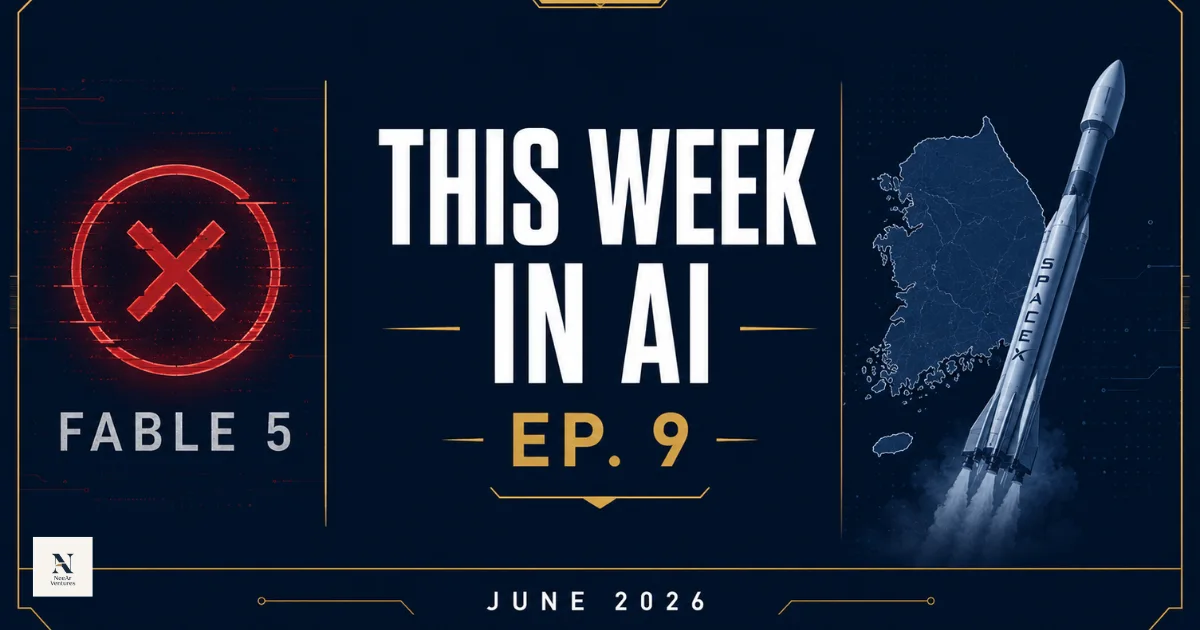
Eight days ago, Claude Fable 5 went dark — pulled offline worldwide by a US government order three days after launch. It is still offline. But this week, we finally found out why it really happened. The official story was a jailbreak. The real story, reported by WIRED and The Washington Post, is two-step: a South Korean carrier's Mythos access got flagged as a possible China security risk first, and an Amazon-discovered jailbreak escalated it into a total shutdown second.
This week in AI (June 14–20, 2026): Claude Fable 5 and Mythos 5 remain suspended worldwide, eight days after a US export control directive forced both models offline on June 12 — with no confirmed restoration date. New reporting revealed the real trigger: South Korean carrier SK Telecom was flagged by the White House over a suspected China security link tied to its Mythos 5 access, which escalated into a blanket ban after Amazon researchers separately flagged a Fable 5 jailbreak. Separately, SpaceX agreed to acquire AI coding startup Cursor for $60 billion, OpenAI acquired Python tooling company Astral, and China announced a $295 billion national AI infrastructure plan.
This is what a fast-moving AI news week actually looks like: a still-unresolved government shutdown, a $60 billion acquisition four days after an IPO, and a major Asia expansion landing in the middle of both.
1 Claude Fable 5 Is Still Offline — and the Real Shutdown Story Finally Came Out
What happened
Claude Fable 5 and Mythos 5 remain suspended as of this writing — eight days after the US Commerce Department's export control directive forced Anthropic to pull both models worldwide on June 12. The in-product banner still reads “Claude Fable 5 is currently unavailable,” Anthropic's official status page lists the incident as ongoing, and independent API checkers confirm no restoration as of late June 19. Anthropic's Managing Director of International, Chris Ciauri, said at a Seoul press conference on June 17–18 that the company was “very confident” restoration would happen “in the coming days” — the most specific timeline given so far, but still unconfirmed.
The bigger news this week is why it happened. Reporting from WIRED and The Washington Post on June 19 laid out a two-step sequence that hadn't been public before.
The White House identified SK Telecom — South Korea's largest carrier and a $100 million Anthropic investor with an active commercial AI partnership — as a potential national security concern over a suspected China link tied to its access to Mythos 5. SK Telecom has firmly denied any China linkage.
Around the same time, Amazon researchers separately flagged a jailbreak vulnerability in Fable 5. That combination escalated the response from “revoke one customer's access” to “block all foreign nationals from both models, everywhere.” David Sacks, co-chair of the President's AI council, had reportedly given Anthropic an ultimatum before the directive: fix the jailbreak, or de-deploy the model voluntarily.
What it means
This reframes the entire episode. It wasn't simply “a jailbreak was found, so the model got pulled.” It was a geopolitical access concern about one specific customer that got bundled with a technical vulnerability into a single, blanket, worldwide shutdown — because Anthropic had no way to selectively restrict one customer in real time.
A narrow, customer-specific national security flag escalating into a global product shutdown is a different — and arguably more alarming — failure mode than “the model was unsafe.” It suggests the blast radius of a single flagged relationship can now extend to every user of a model, anywhere, instantly — and that the outage can run far longer than a purely technical fix would require, because it's tangled up in a geopolitical negotiation rather than a patch.
Negotiations between senior Anthropic technical staff and White House officials are reportedly ongoing. Whatever remediation steps eventually satisfy the Commerce Department, Anthropic has not detailed what they involve, and there is still no confirmed restoration date.
Enterprise customers now know a model can go dark globally — for over a week, and counting — over a dispute involving someone else's access, with zero advance notice.
— NeeAr Ventures Editorial
The new term to know: “Hardware sovereignty” — controlling your own model weights rather than depending entirely on someone else's hosted model — became a real enterprise planning term this week, not just a talking point.
2 SpaceX Buys Cursor for $60 Billion — a Week After Going Public
What happened
On June 16–17, 2026, SpaceX confirmed it will acquire Anysphere, the company behind AI coding tool Cursor, for $60 billion in an all-stock deal expected to close in Q3 2026. The acquisition rights trace back to an April agreement that would have required SpaceX to pay $1.5 billion in breakup fees and hand over $8.5 billion in computing resources had it walked away.
Cursor was mid-raise on a $2 billion round at a $50B+ valuation — with Andreessen Horowitz, NVIDIA, and Thrive Capital participating — when SpaceX's offer came in above that mark. Microsoft had examined acquiring Cursor and passed; Cursor had separately turned down two approaches from OpenAI, prioritizing independence until SpaceX's offer. Cursor's four cofounders will each be worth an estimated $2.7 billion on closing.
The deal lands just four days after SpaceX's record IPO. SpaceX shares have climbed more than 56% from the $135 offer price since debut, briefly overtaking Amazon to become the world's fifth most valuable company.
What it means
This is SpaceX explicitly entering the AI coding tools market — directly competing with Anthropic (Claude Code) and OpenAI (Codex) — using IPO capital within days of going public. It also confirms something about Cursor's trajectory: from OpenAI accelerator alumnus to $60 billion acquisition target in roughly two years, a speed of value creation that dwarfs comparable developer-tool acquisitions (GitHub: 7 years to $7.5B; Figma: 9 years to an $18B attempted deal).
For Anthropic and OpenAI, this is a new kind of competitor — not another AI lab, but a well-capitalized aerospace-and-AI conglomerate with effectively unlimited compute ambitions, now owning one of the most-loved developer tools in AI coding. Combined with SpaceX's existing role as a major compute landlord — Anthropic alone pays SpaceX $1.25 billion a month for Colossus 1 capacity — the lines between “AI lab,” “infrastructure provider,” and “AI product company” are blurring fast.
3 Anthropic's Seoul Expansion Lands in the Middle of the Shutdown Story
What happened
On June 17–18, 2026, Anthropic opened a new Seoul office and announced major enterprise deployments across South Korea: NAVER deploying Claude Code organization-wide, Samsung SDS rolling out Claude Cowork and Claude Code across Samsung Electronics, LG CNS deploying Claude across LG Group, Hanwha Solutions deploying Claude via AWS Bedrock with in-region data residency, and Channel Corp powering its Channel Talk platform (230,000+ businesses) with Claude. Japan's Finance Minister separately announced that Japan's government and its three largest megabanks will gain Claude Mythos access through Project Glasswing.
What it means
The timing is unavoidable: Anthropic announced its biggest Korean enterprise push in the same week reporting revealed that a Korean company's access was the actual trigger for the global Mythos/Fable shutdown. That's not a contradiction so much as a reminder that Anthropic is running two different relationships with South Korea simultaneously — deep commercial trust with NAVER, Samsung, and LG, and an unresolved national-security question hanging over SK Telecom specifically. Those are not the same thing, but in a single news cycle they look related, and Anthropic will have to manage that perception carefully going forward.
Quick Hits This Week
- OpenAI acquires Astral, the company behind Python developer tools uv and ruff, to fold into Codex — giving OpenAI control over a widely-adopted piece of the Python development workflow its coding agent operates within.
- China announces a $295 billion national AI infrastructure plan — 2 trillion yuan over five years for interconnected national AI data centres, with at least 80% domestic technology including Huawei chips; total investment with power grid integration could reach $740 billion.
- G7 AI working lunch brought Amodei, Altman, and DeepMind's Demis Hassabis together this week, alongside reported SoftBank commitments — a rare joint appearance from the three lab heads during an active US-Anthropic regulatory standoff.
- Google made Gemini 2.5 Flash the default model across all Gemini products, even as Gemini 3.5 Pro remains in limited Vertex AI enterprise preview with no public GA date yet confirmed.
- The Fed held rates at 3.50%–3.75% in new chair Kevin Warsh's first meeting — relevant backdrop for anyone tracking the financing environment behind this summer's AI IPO wave.
What This Week Actually Tells Us
The defining fact of this week isn't “Fable 5 is back online” — it isn't. It's that eight days in, the full story behind why it went offline turned out to be more complicated, and more uncomfortable, than the original jailbreak explanation suggested. A geopolitical access concern about one specific customer relationship escalated into a global shutdown of two flagship products — and the company couldn't selectively contain it, and still hasn't found a way back online.
That's the real lesson for anyone building on frontier AI right now: the failure mode to plan for isn't “the model becomes unsafe.” It's “someone else's relationship with the provider becomes a problem, and you get caught in the blast radius, for an indefinite period.” Multi-provider routing and model-weight ownership aren't paranoid hedges anymore — they're a direct response to something that just happened, in public, to one of the most safety-conscious labs in the industry.
Meanwhile, capital keeps moving regardless. SpaceX spent $60 billion on a coding startup four days after its IPO closed. China committed $295 billion to AI infrastructure. The money is not waiting for the policy questions to resolve. Stay curious.
The US Commerce Department issued an export control directive on June 12, 2026, ordering Anthropic to suspend Fable 5 and Mythos 5 for all foreign nationals worldwide. Reporting from WIRED and The Washington Post on June 19 revealed the shutdown followed a two-step sequence: the White House first flagged South Korean carrier SK Telecom's access to Mythos 5 over a suspected China security link (which SK Telecom denies), and Amazon researchers separately flagged a Fable 5 jailbreak. The combination escalated the response into a blanket global shutdown rather than a narrower, customer-specific restriction.
No. As of this writing, Claude Fable 5 and Claude Mythos 5 remain suspended worldwide, more than a week after the June 12, 2026 shutdown began. Anthropic has said it is “very confident” restoration will happen soon, but no official date has been confirmed. Claude Opus 4.8, Sonnet 4.6, and Haiku 4.5 are unaffected and remain fully available.
SpaceX agreed to acquire Cursor's parent company, Anysphere, for $60 billion in an all-stock deal announced June 16–17, 2026, just days after SpaceX's own record-setting IPO. The deal gives SpaceX a major AI coding tool to compete with Anthropic's Claude Code and OpenAI's Codex, and follows acquisition rights SpaceX had secured back in April 2026.
On June 17–18, 2026, Anthropic opened a new Seoul office and announced major enterprise deployments with NAVER, Samsung SDS, LG CNS, Hanwha Solutions, and Channel Corp, alongside Japan's government and three largest megabanks gaining Claude Mythos access through Project Glasswing.
Astral is the company behind uv (a fast Python package installer) and ruff (a Python linter), two widely-used open-source developer tools. OpenAI acquired Astral this week to integrate its tools into Codex, OpenAI's AI coding platform, giving it more control over the Python development workflow its coding agent operates within.