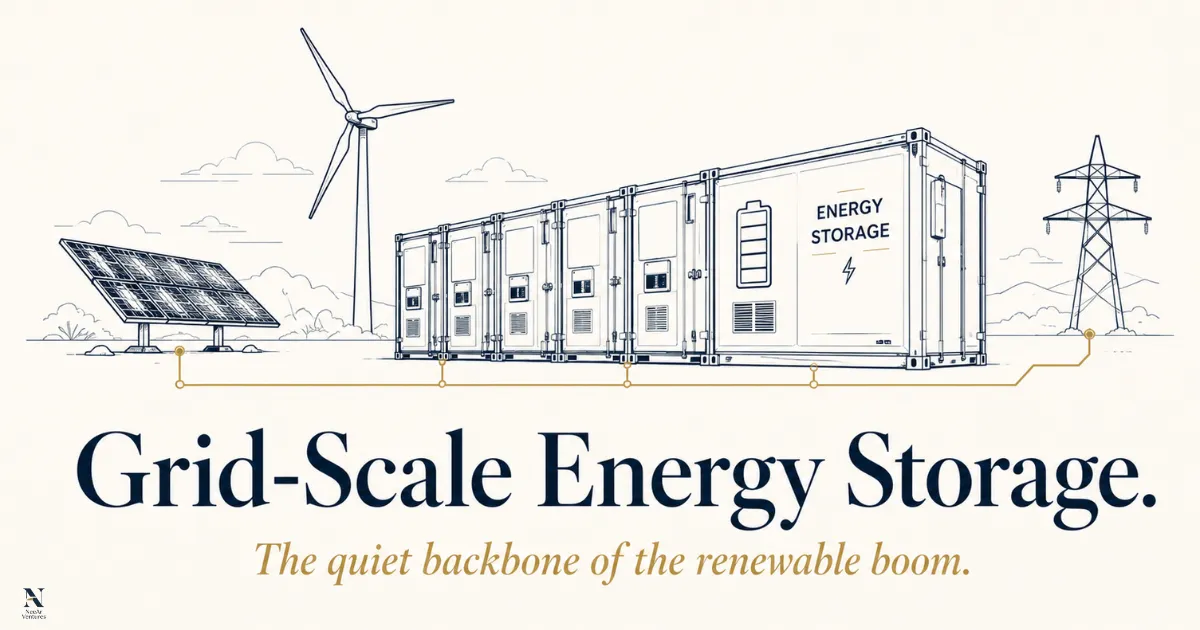
Solar panels generate no electricity after sunset. Wind turbines fall still on calm days. Grid-scale energy storage is the technology that closes this gap — capturing surplus electricity when supply is abundant and releasing it back when demand requires it. It has quietly become one of the most important pieces of infrastructure in the global energy transition.
Grid-scale energy storage refers to large industrial systems — typically ranging from 10 megawatts to multi-gigawatt scale — that store electricity from the power grid and release it back when demand rises or supply drops. The most widely deployed form today is lithium-ion battery storage (BESS), alongside pumped hydro, flow batteries, and compressed air systems. These systems allow renewable sources like solar and wind to supply power reliably even when generation conditions aren't ideal — without storage at scale, renewable-heavy grids become unstable.
This article looks at what grid-scale storage actually is, how it works behind the scenes, the main technologies competing for dominance, how large this market has become, and where the industry is heading next.
1 What Is Grid-Scale Energy Storage and Why Does It Matter?
Grid-scale energy storage is large-capacity infrastructure — usually built at 10 megawatts or larger — that captures electricity from the grid and holds it until it's needed elsewhere. Unlike the battery in a phone or an electric car, these systems are designed to interact directly with the electricity network itself, charging and discharging in response to grid-wide supply and demand.
The reason this matters has everything to do with how renewable energy behaves. A coal or gas plant can run continuously and adjust output on demand. Solar and wind cannot — their output depends entirely on weather and time of day. As more renewable generation is added to a grid, the mismatch between when electricity is produced and when it is actually needed grows wider. Storage is what bridges that mismatch.
A grid running heavily on solar and wind isn't unstable because the generation technology is unreliable — it's unstable because supply and demand rarely line up in time. Storage is what allows a renewable-heavy grid to behave like a traditional one: power available on demand, regardless of weather or time of day. The renewables aren't the missing piece. The storage is.
This is why grid-scale storage has moved from a niche engineering concern to one of the most closely watched categories in the entire energy sector — it is, in many ways, the constraint that determines how fast the rest of the transition can move.
2 How Does Grid-Scale Storage Actually Work?
At its core, grid-scale storage follows a simple cycle: charge when electricity is abundant or cheap — typically during midday solar generation — and discharge when demand peaks, usually in the evening. The system absorbs surplus power instead of letting it go to waste, then feeds it back into the grid hours later.
Beyond this basic cycle, grid-scale storage performs three critical services that keep the wider electricity network stable:
Electricity grids must maintain a precise frequency (50 or 60 Hz depending on the region) at all times. Storage systems can inject or absorb power within milliseconds — far faster than traditional power plants — making them ideal for keeping grid frequency stable second by second.
Electricity demand spikes at predictable times — typically early evening, when solar generation is dropping but household demand is rising. Storage discharges during these peaks, reducing strain on the grid and lowering the need for expensive, fast-start backup power plants.
After a major outage, restarting a grid from zero is a complex process that traditionally relies on specific power plants designed for the task. Battery storage systems can provide this "black start" power, helping bring the grid back online faster after a blackout.
Think of it this way: grid-scale storage doesn't generate power — it's a shock absorber for the electricity grid, smoothing out the gap between when power is made and when it's actually needed.
3 What Technologies Are Used for Grid-Scale Storage?
No single storage technology dominates every use case — different technologies are suited to different durations, from seconds of frequency support to seasons of energy balancing. Four technologies currently lead the field.
Battery Energy Storage Systems are the dominant technology today, thanks to fast response times, modular design, and rapidly falling costs. BESS installations can be built in months rather than years, making them the default choice for utilities needing storage quickly. Their main limitation is duration — most are optimised for hours, not days.
Pumped hydro remains the largest source of grid storage capacity globally by far. It works by pumping water uphill to a reservoir when electricity is abundant, then releasing it through turbines to generate power when needed. Its limitation is geography — it requires specific elevation and water availability that most locations simply don't have.
Flow batteries store energy in two liquid electrolytes held in separate tanks, with power generated as the liquids flow through a cell stack. A key advantage is that power capacity and energy capacity can be scaled independently — making them well-suited for longer-duration storage. They also tend to be safer and longer-lasting than lithium-ion alternatives.
CAES systems store energy by compressing air into large underground caverns or tanks during periods of excess electricity, then releasing it to drive turbines when power is needed. It's a mechanical, large-scale approach with long lifecycles, though it shares pumped hydro's dependence on suitable geology.
The storage technology that "wins" depends entirely on the question being asked — milliseconds, hours, or seasons each demand a different answer.
— Grid Storage Industry Perspective
4 How Big Is the Grid-Scale Storage Market Right Now?
The grid-scale storage market has moved from a developing niche to one of the fastest-growing categories in global energy infrastructure. Approximately 92 gigawatts and 247 gigawatt-hours of storage were installed worldwide in 2025 — around 23% more than the year before — with even higher installations expected in 2026.
Three forces are driving this growth. First, renewable energy penetration continues to climb across nearly every major grid, increasing the need for storage to manage intermittency. Second, national decarbonisation policies are increasingly treating storage as essential infrastructure rather than an optional add-on. Third, and perhaps most importantly, battery manufacturing costs have fallen enough that grid storage is now frequently the most economical way to manage peak demand — cheaper, in many cases, than building new gas-fired peaking plants.
Regionally, a small number of markets account for the bulk of new capacity. In the United States, Texas's ERCOT grid and California's CAISO grid are both expected to exceed major capacity milestones well ahead of the rest of the country, driven by a combination of renewable buildout and grid operators actively procuring storage as a planning tool.
From a financing perspective, grid-scale storage has also become a significant investment category in its own right — utilities, independent power producers, and infrastructure funds are increasingly treating storage assets the way they once treated power plants: as long-term, revenue-generating infrastructure.
5 What's Next for Grid-Scale Energy Storage?
The next phase of grid-scale storage isn't about choosing one winning technology — it's about combining several to cover different timescales simultaneously. Multi-timescale storage architectures are emerging that pair fast-response systems, such as supercapacitors, with slower, longer-duration systems like flow batteries, coordinated through increasingly sophisticated control software.
Artificial intelligence is playing a growing role in this coordination. Reinforcement learning approaches are being developed to optimise when storage systems charge and discharge — balancing economic factors (when electricity is cheapest) with safety and grid-stability requirements in real time.
Despite the rapid growth, a significant gap remains. Research suggests that grids integrating high shares of renewable energy should ideally have storage equal to around 15% of total grid capacity for optimal stability — a target most grids globally are still far from reaching. This gap is, in effect, the runway for continued growth in the sector over the coming decade.
On the technology side, research into next-generation battery chemistries continues, including layered flow-battery membranes designed to push energy retention and performance further. And as storage becomes more deeply embedded in grid control infrastructure, cybersecurity is emerging as a critical design requirement — these systems are no longer just batteries, they're part of the grid's operating nervous system.
What This Means for You
Grid-scale energy storage rarely makes headlines the way new solar farms or wind projects do — but it's quickly becoming the piece of infrastructure that determines how fast the rest of the renewable transition can actually move. Whether you're following this as an energy enthusiast, an investor, or simply someone curious about how the grid of the future will work, storage is one of those unglamorous technologies worth watching closely. As costs continue to fall, it may become as fundamental to power grids as transformers and transmission lines are today. Staying curious about the infrastructure behind the headlines is often where the most interesting insights are found — and that's exactly the kind of exploration we enjoy at NeeAr Ventures.
Grid-scale energy storage refers to large industrial systems that store electricity from the power grid and release it back when needed. These systems range from 10 megawatts to multi-gigawatt scale and use technologies like lithium-ion batteries, pumped hydro, flow batteries, and compressed air. Their main role is to balance electricity supply and demand, especially as more renewable energy enters the grid.
Solar and wind power are intermittent — they don't produce electricity at a constant rate throughout the day. Grid-scale storage captures excess renewable energy when production is high and releases it when production drops or demand rises. Without storage at scale, grids cannot rely heavily on renewables without risking instability or blackouts.
The main types are lithium-ion battery storage (BESS), pumped hydro storage, flow batteries, and compressed air energy storage (CAES). Lithium-ion batteries are currently the most widely deployed due to fast response times and modular installation. Pumped hydro remains the largest by total capacity globally but is limited by geography.
The global grid-scale storage market was valued at roughly 40.7 billion dollars in 2024 and is projected to reach approximately 151.2 billion dollars by 2029. Global installations reached about 92 gigawatts and 247 gigawatt-hours in 2025, around 23 percent higher than the previous year. Growth is being driven by falling battery costs, renewable energy expansion, and supportive government policy.
The future involves combining multiple storage technologies to handle different timescales, from millisecond grid stability to seasonal energy balancing. Artificial intelligence is increasingly used to optimize when systems charge and discharge for maximum efficiency and grid stability. Most grids still fall short of the storage capacity needed for high renewable penetration, meaning continued rapid growth is expected through the rest of the decade.